Posts

Showing posts with the label Discourse

Building my Royal Army

Image
  Battle of Lewes by Andy Gammon Before getting into the meat of this post, I'd like to refer you to the following website by illustrator Andy Gammon whose image I have included above:  https://andyggammon.myportfolio.com/projects His illustration is clearly of Lord Edward crashing into the London Militia, leading the vast cavalry host of the Royal army. *** Alright, onto my considerations for purchasing figures for my Royal army. I've not yet finished the rebels but they are all over bar the shouting. I will be retiring within the next 12 months and expect this and my other projects to start seriously accelerating toward their end-state ... and not before time. As is universally recorded, the Royal host was seriously larger than the rebels in both cavalry especially and in overall numbers. Some have it as high as twice as large as the rebel army. In figure terms I had previously resigned myself to having a number of figures half as large again as my rebel army. My rebel army ...

Bow & Blade: Lewes

Image
Bow & Blade: LEWES Just yesterday (March 12) I was browsing my podcast list in Spotify to see what was new amongst my favourites and I saw that in November last year the gents on the Bow & Blade podcast broadcasted on the battle of Lewes - see above link. This was particularly gratifying for me as they did so in a  response from a request I had posted them some time ago and I received several mentions ... 'Greg from Australia'. I was quite surprised and chuffed. If you don't do Spotify, the episode has been listed on the Medievalist website:  Medievalist: Bow & Blade battle of Lewes  and I won't repeat much of what they wrote. For those of you who might not be aware, the hosts are Professors Kelly DEVRIES and Michael LIVINGSTON. Michael left and Kelly right Whilst neither gentlemen profess to be 13th century specialists, they discussed the battle at some length and it prompted me to give some deeper consideration of Simon de Montfort's dispositions for b...

Fighting within a Great Helm

Image
A happy coincidence is Jason Kingsley's latest posting on YouTube of his experiment with the proto-great helm. This constitutes another valuable piece of experimental analysis  in broadening our understanding of armour in the high middle ages. A take-away for me is an appreciation of how mounted commanders of foot soldiers are more likely to have been armoured. Leading a body of spearmen (for example) a commander has an advantage on horse back - to gain a greater view and appreciation of the tactical environment from the height advantage. The soldiers would be looking to the leader for commands and direction and he is more easily seen - his gestures and voice being elevated above the ranks. Conversely, a commander of foot cannot see nearly as well from behind or within a great helm. He also cannot hear or be heard as well. The sensory deprivation and impact on communication seems likely to me to have seen adoption of a great helm in this role as a last resort under extreme circumst...

Depicting Knights: Great Helms and the Cervelliere

Image
  I'm soon to commence building and painting a bodyguard unit of knights for my Rebel army and for this I have a beautiful selection of 28mm mounted figures and their dismounted equivalents from Crusader Miniatures . The interesting feature of the dismounted knight sculpts is that all of them are depicted fighting on foot and wearing the iconic great helm. These figures look fantastic but I do not believe they are accurately portraying how knights fought on foot, so I thought to put up a short discussion on a subject you won't often find. It really cuts to the purpose and use of the great helm in this period. Perhaps one of the reasons for a lack of discussion on the subject and likely one of the contributing factors in motivating figure sculptors is the scant evidence we have specifically for the mid-thirteenth century. Nevertheless, there are consistencies in development of helmet design preceding, following and cutting through the period which enables a clear and logical ana...

Scots at Lewes

I've been thinking a lot lately about my Lewes project. Whilst it's been years since I last added to the army and I've 75% completed the Rebels, I've turned my thoughts to the Scots who rallied to support the English King. I may not put brush to figure until the new year but in the meantime, I can consolidate my thoughts on the first Royalist units and how I intend to represent them. Scots Division We know from The Scotish Bruses and the English Crown (c.1200 - 1290) (1) that Robert de Brus was present at Lewes with the King. We also know it was Robert de Brus V of Annandale- referred to as 'the Competitor' - grandfather of the famous first and future King Robert I. Whilst Rishanger's Chronicle refers to the Scots present being led by Robert Bruce and John Comyn, Blakely argues that Robert himself was present as a part of King Henry's Household as retainer and thus would have personally fought at the King's side or under his immediate command. He co...

Sharing an Idea: Fall of the Foot

Admittedly, I'm not doing a lot on this project for the time being having been posted to Tonga. I am painting and building but not anything toward this project for the present. Nevertheless, it forever returns to mind. I have been listening to Dan Carlin's Hardcore History and in particular his discussions concerning armies across the ages and their respective styles of warfare. If you aren't familiar with Mr Carlin's broadcasts or other works, he is no academic as such but a public broadcaster. A Bachelor graduate in history much like myself, he has a lifelong interest and studies human history including warfare, politics and religion. I have only just discovered his podcasts which I find to be entertaining and thought provoking. He is quite clearly a thinker. Mr Carlin was specifically discussing the failure of Eastern armies over the past three hundred or so years and conversely, the general comparative failure of western armies prior to this. It is a general, mul...

Walter de Cantilupe: Bishop of Worcester

Image
Walter de Cantilupe, Bishop of Worcester was the leading ecclesiastical proponent of the attempts at church and governmental reform. Walter took de Montfort's part in rebellion during the second Barons War, taking the lead role as advocate from his high-minded and reforming mentor Robert Grosseteste, the former Bishop of Lincoln. The two churchmen had been at Oxford together in the 1220s, Walter was attaining his Master's Degree and Robert lectured there. Formerly a clerk of the King's exchequer by 1215 and a one time justice, be entered holy orders and received consecration as Bishop of Worcester in 1237.  Between 1208 and 1236 Walter had held a total of thirteen benefices and ecclesiastical offices at one time or another but had not been consecrated until after his attainmet of his Bishopric. Some of these 'estates' had been royal but others were hereditary including Brailes at Kenilworth. Moving from courtier to rebel, Walter became opposed to Papal polic...

FLAGS: To be or not to be

I'm currently finishing the painting of my latest unit of foot and have decided from this point to start making my armies flags. Each unit will have it's own flag to follow as logic and rules convention both dictate. My research has been revisited and at this time it may prove instructive to anyone dabbling in this specific period (mid-thirteenth century) to lay the ground rules for flags. Whilst various flags abound throughout and originating from the medieval period, there are only two types permitted in an army for Lewes (1264). Whilst Standards, Pennons (or pendants), Banners and gonfalons, pinsels and guidons are all types of flags familiar to the wargamer of the broadly defined medieval period, we are only permitted Banners and Pennons . PENNONS are perhaps the simplest to comprehend as they are the smaller, triangular flags attached to the end of a knight's lance for which every knight on the field was entitled to and may very well have carried. It was in fact ...

Quest for Accuracy: Curse of the Pedant

Image
I suppose the poser here is what's wrong with this image? The short answer is nothing of course. The above image is taken from L'Estoire del Saint Graal & L'Estoire de Merlin ( Bibliothèque nationale de France MS Français 95, c.1280-1290) but this is the rub ... for me. This is the earliest depiction to my understanding of the oft named 'sugerloaf helm' and the earliest date for this illustration as my insert states is 1280. Up to this time, all effigies, illustrations or finds for that matter (precious few) depict the great helm as an essentially flat-topped affair. The above seal of John deMontfort dates from 1270 and clearly shows the flat-topped great helm which is incidentally paralleled by all other surviving and datable evidence up to the abovementioned sugerloaf appearance by 1280. Whilst most followers of this blog are no doubt conversant with developments of arms and armour throughout the medieval period, I have been reminded recently of the co...

Resumption of Services

Image
Like Simon de Montfort, I fought for what I believed in yesterday and lost. In stead of the field at Evesham, my battleground was in the Family Court and instead of death and severed limbs, it was my family which was dismembered. Having returned to Australia at my children's request, they have now been separated from me as their Mother moves to Sydney from Canberra and takes them with her. The upside is (and there is always an upside) that I take sole possession (if not yet ownership) of the abandoned family home. This Monday I move back into my house, back into my shed and as soon as I re-establish myself, Project Lewes will once more shake off the inertia of circumstances and drive forward. Keep the faith and stay tuned.

BLOG ATROPHY

It's been a long time between posts on this, my second of four blogs. Some of you may have wondered on the silence and I still see that it has forty followers who may like some sort of explanation. I can promise that this project has not been abandoned. In January of this year I was posted to the Kingdom of Tonga in an advisory role for two years. Two months into that deployment I became officially separated from my wife of 17 years - such is life it seems and more common than not. Events have conspired to reduce my predicted flow of output to a trickle and I see with some alarm that I have not progressed this Blog or it's parent project since last December. I have been compelled to cut that mission short and will be returning to Australia at the end of the year. I have parenting arrangements to 'negotiate' and accommodation to sort out so it may yet be a little while till life's equilibrium is restored and I can continue my project(s) in earnest. In the mea...

Peasant Soldiery: Discourse

It's been some time since I progressed this blog and my project for that matter. I have not been completely idle; however, having purchased a goodly quantity of synthetic teddy-bear fur and sourced polystyrene for the terrain. More on the table-top plans soon. What I did want to briefly discuss was the concept and notions surrounding peasant soldiery and their makeup within the Montfortian army at Lewes. PRE-CONCEPTIONS In spite of much work having been done in the last two generations within academia to rectify enduring misconceptions, peasantry are largely regarding today as being wholly constituted of a downtrodden serfs, wallowing in agrarian poverty, bounded by hopeless illiteracy and living in an ignorance barely one level above the beasts in their charge. If you were to conduct random interviews with people in the high street, the lingering notions of rag-clad unfortunates, less capable and clever than ourselves would be the consistent theme. Even in wargames...

Getting it Right

I had cause to spend about nine hours today hogging the family computer and pouring through the Internet to build on my research for this wargaming project of mine. I am currently in the middle of painting my knights of the Rebel Left Ward and realised I needed just a couple of extra knights details for my unit. I had anticipated having half of them as sergeants but only a few are really suitable for that rank, the rest of the figures just work better as knights. In stumbling about I struck out more times than I care to think about - chasing lines of enquiry and failing to flesh out the stories of known rebels. For example: I have a list of some 19 rebels recorded as having receive the kings pardon in June 1267 from the Patent Rolls and after many unsuccessful attempts I only managed to satisfy myself that one of them could have been at Lewes. Of course, I then need to identify his heraldry and thankfully did so.   During this exercise I realised to my shock that I had made a c...

Armies & Warfare in the Middle Ages: Review

Image
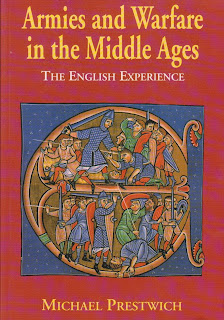
When it comes to analysis of thirteenth century tactics and doctrine of warfare, there remains a lot yet to be written. Plugging some of the gaps is this worthy tome by Michael Prestwich who concentrates on the English experience with a particular emphasis on the thirteenth and fourteenth centuries, making it a must have for my money. First published in 1996 through Yale University Press, Professor Prestwich (Durham University) draws together every conceivable reference from chronicles to public records, royal records and pictorial studies to paint a picture of how English medieval armies functioned. I have at this time principally read the chapter dedicated to Infantry (Chapter 5, pp 115-147 2006 reprint) together with his forward and first chapter on the Nature of Medieval Warfare . Whilst reference to particular battles is made and the book provides a vital context to appreciating the army organisations present at the time of Lewes, Professor Prestwich is direct in admitting h...

Discourse: Impetus for Battle

In a previous post (Book Review: E.L. Mann’s ‘The Battle of Lewes’) I referred to Mann’s analysis of the motivation for engagement at Lewes. Mann believed that the forces were near to equal and that the battle fell in favour of de Montfort when King Henry gave up his advantage of a strong defensive position from within Lewes. Furthermore, the drive for coming out to battle is explained in terms of the knightly class pursuit of glory in a chivalric tradition. From my discourse on the subject of the size of the armies present at Lewes in 1264 (Discourse: How Big was Lewes?) my position on the armies remains that there existed a Royal superiority in the vicinity of 3:2 or greater. If so, Mann’s estimation of numbers is at odds with mine. This in turn undermines any sympathy I can have with criticism of Henry in giving up a necessary defensive advantage. On the contrary, his superiority was more than quantitative inasmuch as his overwhelming advantage in heavy cavalry would have given t...