Posts

Early Blazon Website (12th & 13th Centuries)

This is my first link and a rather handy one at that. It's website in both French and English covering a vast array of early blazons (as the name suggests) with the heraldic designs of just about everyone I have come across to date. It also has a very handy battle index with key people present and their arms. It is accompanied with a basic precis of each battle. Whilst my research is more comprehensive, it is nevertheless a very handy place to begin and I recommend it highly for anyone embarking on a similar battle-build in this period. If it's still running by the time I get to the so-called First Barons War, it will be one of my first ports of call. Early Blazon: Lewes I don't seem to be able to link you straight into the Lewes chapter, so just click on 'Battle' link in the left margin and pick your battle.

Getting it Right

I had cause to spend about nine hours today hogging the family computer and pouring through the Internet to build on my research for this wargaming project of mine. I am currently in the middle of painting my knights of the Rebel Left Ward and realised I needed just a couple of extra knights details for my unit. I had anticipated having half of them as sergeants but only a few are really suitable for that rank, the rest of the figures just work better as knights. In stumbling about I struck out more times than I care to think about - chasing lines of enquiry and failing to flesh out the stories of known rebels. For example: I have a list of some 19 rebels recorded as having receive the kings pardon in June 1267 from the Patent Rolls and after many unsuccessful attempts I only managed to satisfy myself that one of them could have been at Lewes. Of course, I then need to identify his heraldry and thankfully did so.   During this exercise I realised to my shock that I had made a c...

WAB Rebel Army List (Version 4)

Rebel Army V4

Rebel Left Ward Knights: Research and Heraldry

Left Ward Knights V2

Rebel Left Ward - London Foot (1): Modelling

Image
This is the most daunting painting task I have set myself - a unit of 70 spear and 12 archers. Construction of the figures alone took over a week (a busy life schedule). The unit is to represent the London levy or trained militia men if you prefer. Whilst they ultimately fell to the royal cavalry I suspect it was no walk-over and contemporary chronicle accounts are most likely a simplified account of what transpired. Whilst these men had not fought in an open battle of the likes of Lewes, they were no strangers to armed conflict when it came to controlling London and resisting would-be-oppressors including the King. Charged with protecting the city, I have depicted them as well armed and relatively drilled troops. The manufacturers represented in this unit include almost even proportions of Kingmaker Miniatures , Curtey's Miniatures , Essex Miniatures , Foundry ,  Gripping Beast and Mirliton Miniatures . I have swapped shields, spears, made other spears, cut a...

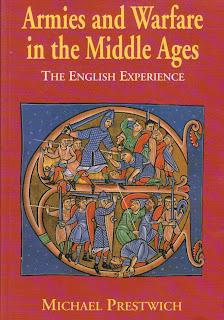
Armies & Warfare in the Middle Ages: Review

Image
When it comes to analysis of thirteenth century tactics and doctrine of warfare, there remains a lot yet to be written. Plugging some of the gaps is this worthy tome by Michael Prestwich who concentrates on the English experience with a particular emphasis on the thirteenth and fourteenth centuries, making it a must have for my money. First published in 1996 through Yale University Press, Professor Prestwich (Durham University) draws together every conceivable reference from chronicles to public records, royal records and pictorial studies to paint a picture of how English medieval armies functioned. I have at this time principally read the chapter dedicated to Infantry (Chapter 5, pp 115-147 2006 reprint) together with his forward and first chapter on the Nature of Medieval Warfare . Whilst reference to particular battles is made and the book provides a vital context to appreciating the army organisations present at the time of Lewes, Professor Prestwich is direct in admitting h...

London Heraldry: Research

Image
The above London coat of arms is taken from the earliest surviving example from the 16th century and obviously (perhaps) of a construct developed long after the 13th century. Nevertheless, the principle shield device or blazon is understood to be from a much earlier time from 'ancient usage'. Like so many within the European or christian world, the cult of St. George and the dragon held fast in the imagination of people and clearly the citizenry of London were no exception.  The cross of St. George appears to have had a sustained period of adoption from the crusades in Outremer, particularly adopted by the Templars, and endures today in the flag of England. So, I too will be adopting this device for many of my London militia in the left ward under Nicholas de Segrave at Lewes. Whilst the Guilds dominated the urban social, economic and political landscape of London, specific liveries do not appears to have been an outward feature of organisation or represent...